


How to get into WU BBE?
Updated: Mar 23
WU BBE is an English-taught bachelor's of Business and Economics at WU (Vienna university of Economics and Business), a QS World University Rankings top ranked university (59th spot) which had around 3700 applicants for 240 spots last year (I would expect it to be lower in 2026 due to the sudden change from 5 years of online format to the offline one to ensure everyone writes the exam in honest and fair/same conditions)

1. Do not let the high number of applicants scare you.
Every year 240 real people (some straight after high school, some after 1 year of university elsewhere, some after working for a few years already) make it and start their WU BBE studies, so if they can, so can you 👩🏼🎓🧑🏽🎓
2. Study! As simple as it sounds, that's the key.
2026 is a unique opportunity of (very likely) less applicants than before, so if you know you can make it on the 30th of June to Vienna, take full advantage of that opportunity to end up in a cohort with smart&motivated colleagues (I studied for 6 months for the WU BBE entrance exam back in 2019 and it was so so worth it! Despite there being almost nothing to prepare with, all the stress and thinking "Wow, everyone around me looks so smart, what am I even doing here?" I made it right after high school and ever since then I made it my mission to help you achieve the same with less stress&in a more organized manner)📚
How to study?📝
Maths: the part about which I get the most questions
There are 13 topics listed on WU’s website starting from Logic and ending with Binomial distribution and there will be 1 question per topic with the name of the topic written right above it (so your brain can automatically narrow down the formulas you will be using)
And if you are starting your preparation these days you still have enough time to cover all the topics well because with every topic being asked you cant really hope to get lucky and think “oh, I dont like differentiation so maybe it wont show up so I wont study it” because that wont be the case🤓
Also, you might think that you love the topic polynomial functions and dont like the topic elementary financial mathematics BUT on the exam the elementary financial mathematics question might turn out to be much easier and nicer than the polynomial functions one, so studying all the topics now will help you maximize the points you get on the WU BBE entrance exam and that is what matters most (as you dont need 100% to get in, throughout the years you needed 78-86.8% to get in)
Start studying sooner than later to make sure you know all the theory and properties and formulas so well that when you are reading the question you immediately start noticing what you need to solve it (e.g., in a power functions question if you have the formula f(x)=4x^a and you have a point that when x=10 then f(x)=25, then by plugging those values in the the function 25=4*10^a you can easily find “a” and proceed to solving the 5 statements in this question)
With the 2 hours given for all 3 parts (33 questions, 5 statements each, so 165 mini tasks for you to solve) each minute matters so to have the time to solve everything you cant spend 5-10 minutes thinking on how to approach the task). Exams at WU are generally made in a way that you have just enough time to solve everything IF you know exactly what you are doing and dont stop writing (that was the case for BBE math subjects, for one of my accounting specialization exams and also during the two very technical subjects at DigEcon master’s), so welcome to our study community😉
WU can ask any math topic in any format (a scenario-based task with a lot of text about a company that wants to maximize its profits, a task with an equation of a function that you have to work with, a task with a table of data points or a graph of f(x) or f’(x) for you to analyze), a task with long equations/inequalities (including the more advanced like the ones with absolute values and etc.)
Also, when you are confident in your knowledge you know when to stop and when it is enough to indicate whether the statement is True or False as sometimes you dont have to fully solve something in the perfect “math scientific” way to figure it out (that’s the beauty of multiple choice-style exams)
For example, if you see an inequality like 5x+|3x-15|>10 and it states that the solution is |x|>5 but since you have studied and know that it will have multiple intervals that solve it, the moment you see an interval where x=3 for example is included that’s it, you know it is FALSE because 3 is not included in |x|>5 so you dont have to continue solving it further
So please make sure you study now to avoid missing some points later🤓 (if you have more subject-specific questions feel free to message me and I will provide you with all the insights I have collected throughout these years (2019-2025)👩🏽🏫)
Economics: the part that weighs the most (40%, 4 points per question)
The questions will be based on the Economics book provided by WU BUT reading it once is usually not enough, especially if you didnt have Economics/Business in school
If you havent started reading it yet I would recommend doing the following:
1. The first time you read it just go through it relatively quickly as a structured overview, just to have an idea in your head of the amount of information you have to know and build up the “palace of knowledge” like Sherlock Holmes (had to make that reference ahah) so that you know in which “shelf” is what and can get it from there when needed
2. The second time you read it you go through all the details, every formula (even if it is in brackets), every concept and how it works, every definition, you pay attention to it, write it down and learn it!
A few comments here:
For concepts like the break-even point (fixed costs divided by selling price-variable cost) and price elasticity (the PERCENTAGE (or also called relative) change in quantity demanded divided by the PERCENTAGE change in price) please look up the general formula and memorize it, as in WU’s book you have a step-by-step example of how to calculate it, but not a separate general formula next to it (and during the exam it will be quite challenging to recreate that example from your memory)
Please memorize the accounting formulas by heart and ALSO know their interpretation (e.g., a current ratio of below one indicates that a part of long-term (also called non-current) assets was financed by short-term (current) liabilities) as they will not be provided on WU’s formula sheet
Please ignore several typos here and there in the book. E.g., in the current ratio/working capital ratio=current assets/current liabilities the first “/“ indicates synonyms (so current ratio=working capital ratio) and the second “/“ indicates division (current assets divided by current liabilities)
3. The third time you read it you revise the book and your notes, make sure you have not only memorized the concepts, but also understand them to the extent that you can apply them to any practical scenario
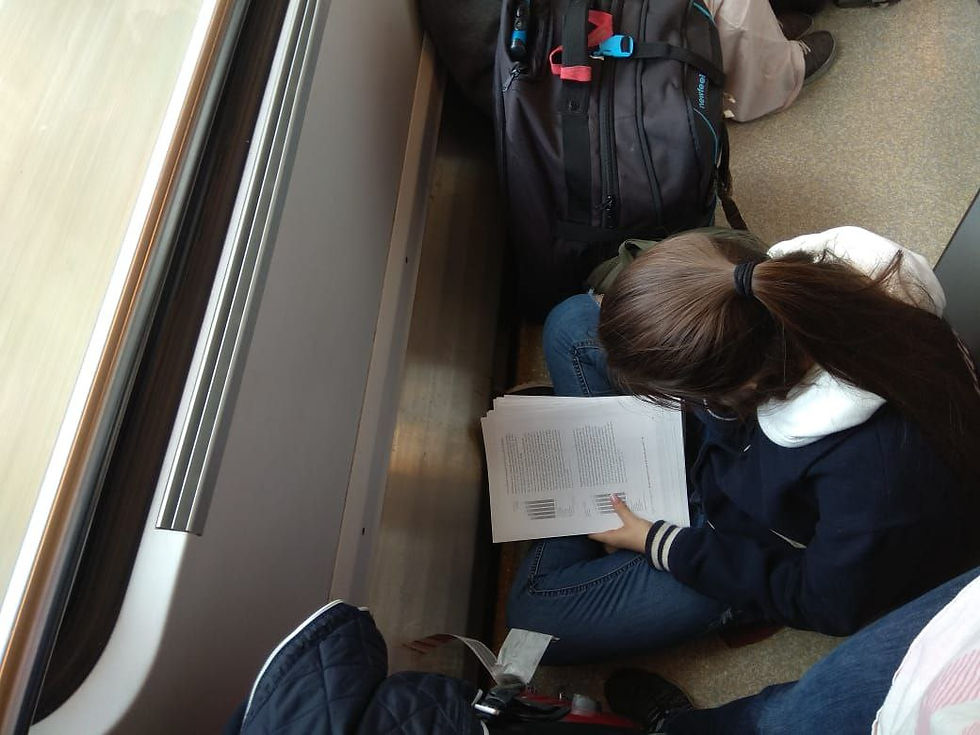
4. The fourth time you read it very close to the exam date as final revision (the last time I read it back in 2019 was on the train on my way to Vienna🤓)
English: This part weighs the least (10 questions, 1-3 points each, 21% in total) so making a mistake here is less of an opportunity cost compared to making a mistake in the Economics part, but you still need to do it relatively well to be in the top 240 of applicants
4 text-based questions 3 points each
3 text-based questions 2 points each
This information is as of the lastest WU BBE entrance exam that took place in 2025 (before there were usually 5 text-based questions and 5 vocabulary/grammar questions)
2 vocabulary-based questions 1 point each
1 grammar-based question worth 1 point
Advice on how to approach the questions&prepare for the English part of the WU BBE entrance exam:
1. For text-based questions:
BEC (Business English Cambridge) reading comprehension exercises would be the closest it gets compared to IELTS or TOEFL texts, as BEC ones have similar vocabulary&topics to what you might expect to come up on the BBE entrance exam
What to expect from the WU BBE entrance exam text: socio-economic topics like rent prices, recycling and etc. and approx. 7 paragraphs long
With 7 text-based questions and each of them having 5 statements it will be hard to use the “read all the questions first, and then come back to the text” strategy because you will forget what the 5 statements in question 1 were about by the time you get to the 7th question
So here a better strategy would be to read the text first to have an overview of it and to see which paragraph is about what and then proceed to the questions while occasionally referring back to the text to double-check a detail or the exact phrasing
Pro tip: since you will be allowed to take notes on the exam questions (at least we could do it back in 2019) you can underline which sentence refers to which statement for some of the questions, it helps a lot not to lose track of where is what and not to fall for traps like double-negations and synonyms vs antonyms in the statements relating to the text
From my 2019 experience:
I spent 3 years in a British-based secondary school in Spain and all my English knowledge I owe to my school teacher there, Ms Amy.
So when I took the IELTS exam with just 2 weeks of preparation and not practicing the reading part that much and got 8.5/9 (C2 level) in the Reading part pretty much effortlessly I decided that I will focus just on the maths&economics part of the WU BBE entrance exam and OH WELL THAT WAS A MISTAKE! because on the exam the text was easy, the questions were also fine, but since I didnt practice the reading comprehension tasks to train the skill of finding information in the text quickly to determine whether the statement is True or False I was feeling the time pressure and it didnt feel nice, let me tell you that. So please, even if you are a native speaker, practice reading comprehension tasks at least 2-3 weeks before the exam to have your brain be “in shape” for those type of questions
For vocabulary-based questions:
Here it is a matter of improving your English vocabulary daily. You never know which word will come up and to minimize the probability of not knowing a particular word, you have to expand your vocabulary on a daily basis, as it is definitely not a one day or a two day job (and of course this is easier for the native speakers but I still heard from someone who grew up in London or from someone who finished IB that the English part was somehow the worst for them out of all 3)
Pro tip: the most efficient way to remember words are not self-made dictionaries or a collection of flashcards but encountering a word multiple times when reading. The first time you see a new word you look its meaning and uses up (not just the direct translation, to make sure you understand its “undertones”) it will go into your short-term memory, and then once you encounter it for a 2nd time it will be more familiar but you might still have to double-check its meaning and then the 3rd time you do so you will already know its meaning So here repetition is key when learning new words An example of academic word lists that you will find helpful would be: ielts-up.com academic writing word lists
For grammar-based questions:
They will really catch you on details here. So revising even the basic grammar rules will come in handy here. I know that once you reach a level of B2+ a lot of sentences are filtered out using the “it sounds right” or “it sounds weird” knowledge-based intuition (and even more so for native speakers) but be careful here, what sounds right at first glance might have a tense mix up with wrong “signal/indicator” words and therefore it will be False :D
My favourite website for that is: https://www.examenglish.com/CEFR/cefr_grammar.htm
as it breaks down all the grammar rules by English language levels (A1-C2)
That would be my main advice per part of the WU BBE entrance exam that proved to be useful to my students throughout the years (2020/21-2025) and would have definitely been useful for 2019 me when I was applying to WU BBE and preparing for the offline entrance exam back then
If you have any additional questions feel free to reach out to me via email
info@bbe-exam.com or via Instagram @maria.teachie
Of course please adjust the frequency & times of reading it according to where you stand in your preparation now!


Comments